University of Hawaii
Ho'ohiapo
The Class of '76
Chapter 4 - Traditional Classes? Close, But No Cigar
We had received a Law School letter in August with
"Preliminary Information"
which generally described the seminars of the Introductory Block and the
classes for the remainder of the semester.
On October 4, 1973,
these were our classes: "Regulation of Economic Activity: Real Property
Law", "Social Decision-Making: Judicial", "Legal Education and the
Profession", "Clinical
Project/ Legal Method Seminar", "Student Workshop" and
"Modern Methodology".
Translation: Real Property, Civil Procedure, Legal
Profession Overview
and Seminar(s). Could "Modern Methodology"
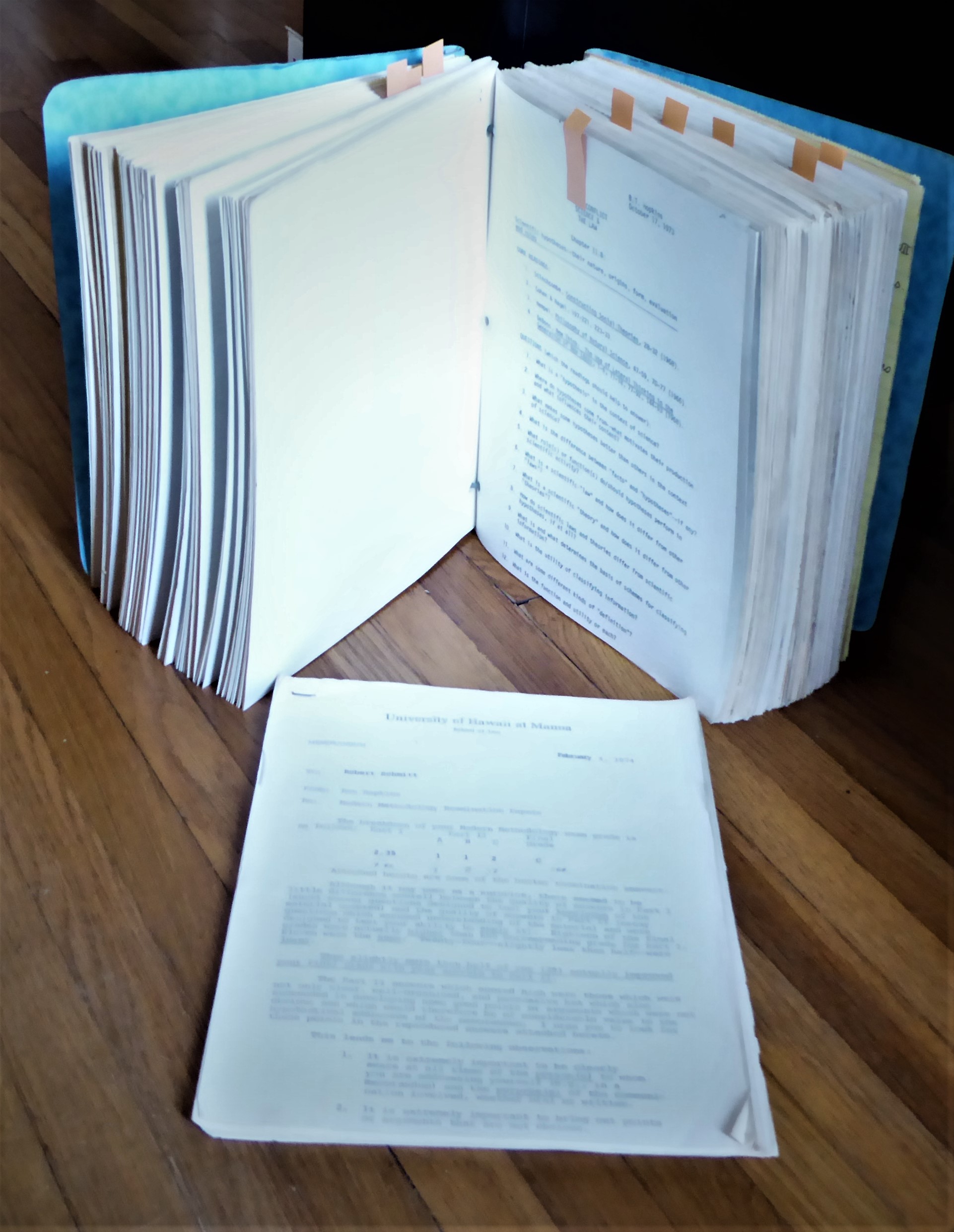
be translated? Patience! The photo below shows our "text book" for
this class, surely an example that "a picture is worth a
thousand words". This tome weighed
ten pounds as shown. In the foreground of the photo is Prof.
Hopkins 53-page critique of our final exam. It included two samples he
considered to be good answers. More on this in the next chapter. Also after the introductory block, assistant
professor of law and librarian Jerome Dupont taught "Methods of
Effective Legal Research" which was part of the Clinical
Project/ Legal Method Seminar without separate credit. We
initially met in six separate groups with Prof. Dupont in the Hamilton Library
. We were supplied with concise handouts describing
source of legal research and had two legal research exercises. In
1973, our research resources were limited to books and journals - microfilm was
eventually available as "high-tech" medium. This was a
useful and very practical course. Currently, online sources have undoubtedly
made our '70s research techniques "old school". "Regulation of Economic Activity: Real Property
Law" was our course in real property
law. It likely was the most
traditional - we had to buy an (actual) property law book: Berger &
Williams "Property: Land Ownership and Use." Professor
Gordon supplemented this book with relevant handouts - only a fraction
of the Modern Methodology quantity! After a few weeks, we had a
practice quiz. The final exam had a similar format - four
questions to be answered in three hours. We received sample answers and general
comments on the exam from Prof. Gordon at the end of December - only
five pages. The next chapter will show a vivid contrast to the 53-page sample answers for Modern
Methodology! This again was a useful
and practical course. "Legal Education and the
Profession" was taught by Dean David Hood. This course was
entirely based on copied articles from books and journals:
"Tentative Course Materials". This title page notes
these would be "trial" materials "preparatory to ultimate
publications in a revised format, to emerge from our collectives
academic experience". Aside from the stated
"experimental" nature of the material, this course seemed to be a
useful experience. We had periodic assignments and the
course continued into the spring semester. "Social Decision-Making:
Judicial" was taught by Professor Richard Miller. As above,
this course was primarily based on copied articles from books and journals:
"Tentative Course Materials". This title page notes
these would be "trial" materials", preparatory to ultimate
publications in a revised format, to emerge from our collectives
academic experience". In addition to the copied material, we
were told to purchase both the federal and Hawaii rules of civil procedure. We
were also encouraged to consult with three standard texts on civil
procedure. Multiple copies of these texts would be available in our library. Aside from the stated
"experimental" nature of the copied material, the course seemed to be a
useful learning experience.
To augment the Real Property course, the separate seminars continued to
meet, still focusing on the Kahaluu Flood Control Project but now the
issue was the ownership of newly created land in Kaneohe Bay if the FCP
carried silt from the floodplain. Another seminar exercise required development of
oral arguments on an issue of civil procedure - the fictional case
concerned the admissibility of oral recollections of a Kaneohe
Bay fishpond "ownership". A further seminar task was slanted towards Modern
Methodology: write an eight-page report, applying logic and other MM
techniques on the relation of the "Atlas of Kaneohe Bay" to the
Kahaluu Flood Control Project dispute. The final seminar task would be a "judicial
process" problem - each student would develop a 30 minute oral
argument between December 3 and December 10 or 12 for presentation
against other seminar members. As expected, the semester ended with final exams in
December. "Social Decision-Making:
Judicial" (Civil Procedure) was a three-part, open-book exam which we
were told could be answered in 3 hours, but up to 6 hours would be
allowed. This exam is
listed on the Sources page. Prof. Miller
later provided us his comments on our answers
and sample acceptable answers in an 18-page handout. Fair enough! "Regulation of Economic Activity: Real Property
Law" was a four-part exam for which we were allowed 3
hours. This exam is
listed on the Sources page. In late
December, Prof. Gordon provided us with an 5-page handout of suggested
answers and his comments. No controversy! To aid our recovery, "Some Law Students"
sent a memo to "All Law Students" about a "Fall '73
Buffet Lunch" scheduled after the last final on December 2.
For $3.00, there was beer on tap, vodka and mixers, soda, meatballs,
teriyaki, chicken, shrimp tempura, sushi, noodles and salad. It
was a good deal and much fun! The entire next chapter
explains the controversial Modern
Methodology final exam.
Next:
Chapter
5 - Modern Methodology Hits the Fan January 4, 2024