|
The Law School Catalog stated the purposes of the second-year curriculum (Fall 1974 and Spring 1975) were to:
"During each semester of the second year every student must take three required courses plus one of three policy practicums, each associated with one of the courses, to wit: Second-year course work provides breadth of coverage. Depth is provided by the policy practicums, which enable every student to devote a total of seven credit-hours* in each semester to one subject-matter area, working with the same teacher. Three in the practicum plus four in the course with which the practicum is associated The coverage provided by course work in the second year is mainly coverage of generic problems. The major objective in each course is to clarify basic issues and to identify some of the better-known arguments advanced for alternative solutions. Another important objective is to acquaint students with solutions embodied in the decisions of legislatures, courts, and other decision-makers."
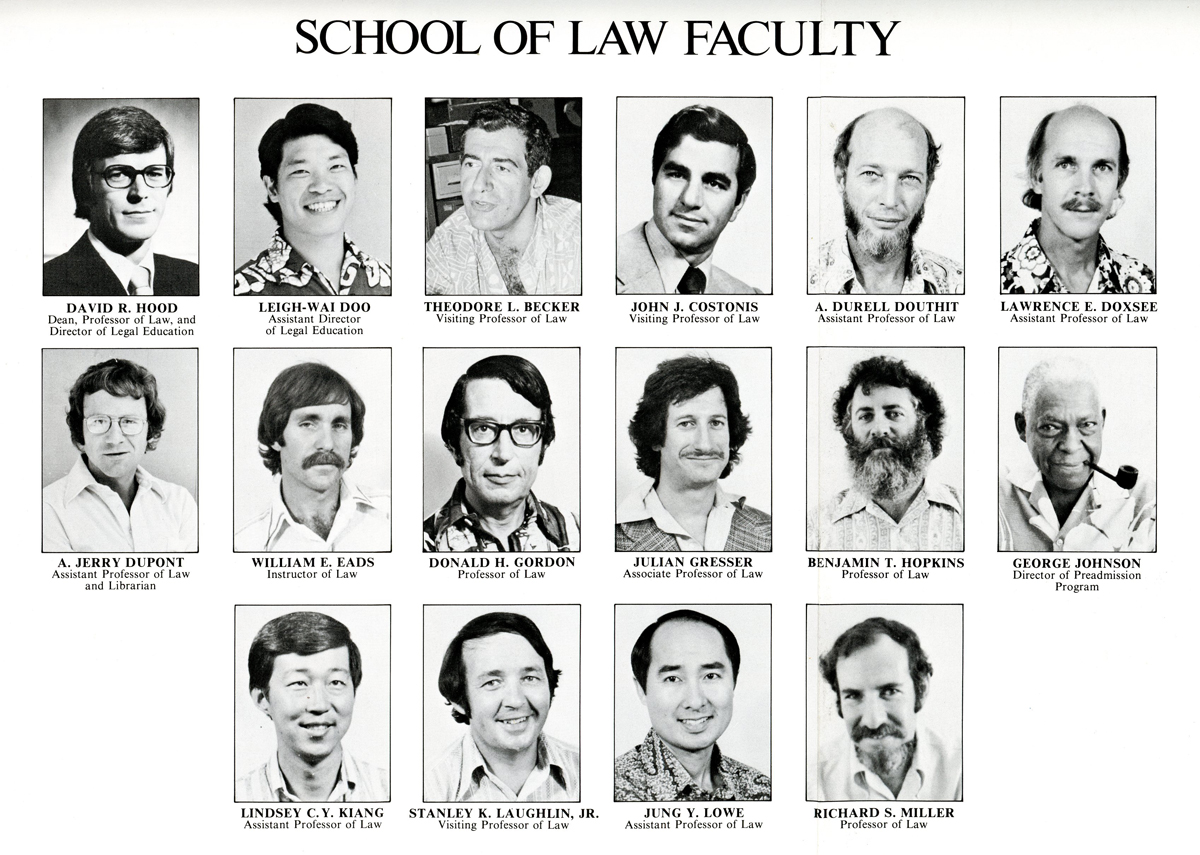
Fall Semester of the Second Year Federal Income Taxation (4 credits) Civil Rights (4 credits) Social Decision-Making III: American Decision-Making Institutions (4 credits) Policy Practicum (in one of the above) (3 credits) Total 15 credits Spring Semester of Second Year Business Law (4 credits) Social Decision-Making IV: Federal Courts and the Federal System (4 credits) Social Decision-Making V: Transnational Legal Process (4 credits) Policy Practicum (in one of the above) (4 credits) Total 15 credits This was the Catalog description of the Courses: Federal Income Taxation (4) I Gordon An introduction to some of the more important problems created by the federal tax on the income of individuals, corporations, partnerships, and fiduciaries. The tax consequences of a variety of common transactions will be explored — e.g., home ownership, charitable contributions, medical payments, and divorce. Special tax problems of wage earners, investors, and business persons will be examined. Considerable attention throughout will be given to the usefulness of the income tax as a means of encouraging or discouraging particular activities, and to the questions raised by rate progression. Students will be expected to develop proficiency in the use of the Internal Revenue Code and the Treasury Regulations. Civil Rights (4) I Laughlin This course deals with substantive rights and liberties secured by the Constitution of the United States (in particular, by the First, Fifth and Fourteenth Amendments) and by certain federal statutes. The primary focus is on how, by whom, and to what extent these constitutional safeguards are and should be enforced through court litigation. The role of the Supreme Court in this regard is critically examined. Topics include the freedoms of speech, press and assembly; "obscenity" and its elusive definition; rights of privacy and travel; equal protection of the laws, particularly as applied to classifications based on race, sex, poverty, age, etc.; and the recent reappearance of "substantive due process." Social Decision-Making III: American Decision-Making Institutions (4) I Becker A study of the ideological and legal norms of important public and quasi-public decision-making institutions in the United States, and of how their actual operation and interaction complies with or deviates from such norms. Institutions examined are the Supreme Court and other federal courts, the Congress, the federal Executive, federal administrative agencies, state and municipal governments, the electoral machinery, and important "private" organizations such as business corporations, labor unions, universities, and foundations. Topics that receive special attention are judicial review (of legislative, executive, and administrative actions), separation of powers, federal/state relations, and the relative degree of popular and elite control of official policy-making. Considerable use is made of material from social sciences such as political science and sociology. Business Law (4) II Kiang A survey of basic legal problems and principles commonly confronted by lawyers who represent or deal with private business organizations. Major topics are forms of business organization, securities regulation, and secured transactions involving goods. The forms of business organization examined include sole proprietorships, partnerships, associations, and corporations; but primary emphasis is given to the formation, financing, control, operation, and sale or other disposition of the closely held corporation. With respect to securities regulation, most attention is given to the circumstances under which an offering of securities for sale must be registered with state or federal agencies. Treatment of these topics requires, among other things, reference to the Hawaii Corporation Law, securities laws, and the Uniform Commercial Code. Social Decision-Making IV: Federal Courts and the Federal Systems (4) II Askin A detailed study of the organization, staffing, and jurisdiction of federal trial and appellate courts, including their interaction with state courts. Topics include constitutional and statutory bases and requirements for original and diversity jurisdiction, review of state court decisions, application of state civil law in diversity cases, appellate procedures, and conflicts of law (situations in which the laws of two or more governments appear to be applicable to the same set of facts). Social Decision-Making V: Transnational Legal Process (4) II Gresser An introduction to a number of transnational legal problems — the treatment of foreign investment in the United States (with emphasis on Japanese investment in Hawaii), the application of international law in domestic courts, the transnational reach of national legal systems, the role of transnational litigation, and the present law of the sea controversy. A major concern throughout is transnational decision-making processes, with particular emphasis on the role of governments (especially the United States and Japan), multinational corporations, other non-governmental organizations, and individuals. A major purpose of the course is to begin preparing students to function effectively when confronted with disputes and decision-making involving persons of different nationalities. Policy Practicum (3-3) Yr. Becker, Laughlin, Gordon, Askin, Gresser, Kiang The primary purpose of the Policy Practicums is to give every student two intensive experiences in the methodology of multi-disciplinary policy analysis —the development of issues and arguments concerning the law's effects on people, using theories and data from all relevant fields of knowledge. A secondary purpose is significantly to deepen each student's understanding of the area covered by two of his/her second-year courses. To the extent possible, policy questions are presented and confronted in the context of actual or simulated client problems. To preserve the benefits of small group instruction, a maximum is imposed on the number of students in each Policy Practicum. Even so, the size of the Practicums requires students to exercise considerable independent initiative and judgment, in the manner of junior members of a law firm or legal staff. What Really Happened - Fall Semester Federal Income Taxation As taught by Prof. Gordon, this course had a very standard approach. We had "Federal Income, Estate and Gift Taxation" by Bittker and Stone with the 1974 Supplement. Also the CCH edition of the Internal Revenue Code and Income Tax Regulations. The copied handout was only 10 pages. Their were a few practice exams. The 3-hour final exam on December 16 was in two parts. The first one-hour part was fifteen questions - with sub-sections - that were answered as "True" or "False" and fill-in-the-blanks. The second part described three situations, each which required a blue book written analysis. In January Prof. Gordon provided us with a four-page "post-mortem". Continuing our first-year's experience with Prof. Gordon, this course was generally ranked high. Policy Practicum Also in the first semester, each of us had to choose one of the three other courses as a topic for a "multi-disciplinary policy analysis". Seventeen students chose federal taxation. This practical exercise in research and presentation was also directed by Prof Gordon. The papers that were written and presented to the entire group had topics ranging from subsidies to low-income housing, to examining progressive taxation to Domestic International Sales Corporations (DISC). High marks from all. Civil Rights Prof Stan Laughlin used "Constitutional Rights & Liberties" by Kamisar and Choker as the casebook for this course. Copied supplements were modest and we had periodic reading assignments for the casebook. There was a mid-term exam on October 21 in which we were encouraged to identify the issues. We were also allowed to designate a percent of this exam for our final grade. The final exam on December 18 was designed for three hours, but we were allotted five hours to fill "18 sides of the blue book page." There was no post-mortem - but the course lacked drama! And that was a plus. Sixteen student selected Civil Right Law for their practicum. Social Decision-Making III: American Decision-Making Institutions In brief, this course was "all over the place". If we thought the copied material hand-outs for Modern Methodology was excessive, the hand-outs for this course topped it by volume and page-count - nearly all were two-sided copies. (Prof) Ted Becker's initial course description was "Constitutive Law, or Social Decision Making III, or American Governmental Decision Making". Of these three choices, what would we study? Material ranged from "The Peter Principle" to Supreme Court decisions. However, eventeen students chose this course for their practicum. One class began with a classmate walking to the front of the classroom and then he lectured us. His topic is lost to history. Student attendance dropped. There were two questions on the final exam, 6 pages long. It was to be written over 24 hours, from noon on December 19, 1974 to noon on December 20. Months later, a student-developed survey/evaluation of this course was sent to all class members. 38 classmates responded to these issues: "Some comments concerning Prof. Becker and his last course:
The survey results were sent to Dean Hood and other faculty. Here is that survey, with student names deleted: Becker Survey Results |
||
| Summary If the above
Becker-dominated Social Decision-Making course could be ignored, the
Fall Semester would be a good step forward for the development of the
Law School. But the Becker survey/evaluation was another black
mark, similar to the April petition to remove Ben Hopkins from further
instruction assignments.
What Really Happened - Spring Semester Business Law This was another by-the book course from Prof Lindsey Kiang. In this case, the book was "Laws of Corporations", 1974 edition with Supplement by Harry G. Henn. The copied material was limited to the Hawaii Revised Statutes of Corporations and Partnerships and regulations on the Uniform Securities Act. Reading assignments were explicit and Prof Kiang provided two recaps on February 20 and April 29. There was a practive exam before the Easter vacation and the final exam was on May 14. Federal Courts and the Federal System Prof Frank Askin designated Hart and Wechsler's "The Federal Courts and the Federal System" and its Supplement as our casebook. Supplemental material was modest - significant federal cases and a New Jersey case in which Prof. Askin was the plaintiff's attorney. Reading assignments were updated periodically. The final exam on May 12 had three questions, but only the first two were mandatory. The third question asked for an appeal brief on the case for which Prof. Askin was the plaintiff's attorney. Practical! Transnational Legal Process We had a new prof, Julian Gresser, but this was another "Paper Chase". There was no casebook, rather we eventually had 9.8 pounds of copied handouts, all double-sided. This was a lot, but not enough to break the record set by Ted Becker. There were four main topics: "Aliens and their Activities within a National Legal System", "International Law and its Relation to National Legal Systems", "Transnational Reach of National Legislation and Related Problems Of Transnational Public Interest Activity" and "Introduction to the Law of the Sea". Dr. John Craven, the state's Marine Affairs Coordinator and dean of the UH Oceanographic Department was a guest lecturer. There were two practice exams. The final exam was on May 16, scheduled for four hours, but five hours could be used. Prof Gresser provided a road-map on techniques to answer the four exam questions, The format for the practicum was the same as the practicum for the fall semester. Each student chose a a specific problem to analyze. Twenty students chose Business Law, seventeen selected Transnational Law and 14 Decided for Federal Courts. In the Transnational practicum, Prof Gresser suggested ten topics that could be analyzed. Thereafter, an initial memo was dues in 4 weeks, 2 weeks later an initial strategy memo was due, 2 weeks after that a detailed strategy memo was expected with a final appendix at the end of the course. At the time of the course and practicum, the deep-sea mining of manganese nodules was a newsworthy issue and federal legislation was proposed to for international regulation of this activity. In the current year, 2023, does anyone ever think of manganese nodules? The Transnational Law course and practicum caused no contemporary controversy. The photo below shows the handouts for both the fall and spring semester. No photos of the casebooks!
From the left: Federal Courts, Business Law, Civil Rights, Federal Income Taxation, Tax Practicum, Transnational Legal Process, Transnational Practicum, Social Decision Making III (three lumps), Criminal Law |

Next: Chapter 8 - The Third Year
Table
of Contents
January 5, 2024